ERP and master-data records maintained and validated
Category Sourcing · MHE Operating Context · ERP & Data
I connect sourcing decisions, supplier capability and reliable data to identify risk early and keep operations on track.
Procurement decisions with the operational impact in mind.
I look beyond the purchase order to capacity, lead time, material availability, quality and documentation, and I stay with the issue until it is resolved.
I bring hands-on sourcing and supplier follow-up, IKEA warehouse and MHE experience and daily AX/D365 and MRP work. I would apply that base to MHE supplier performance, lifecycle decisions and AssetIQ workflow improvement.
Languages: French native · English fluent · Danish operational (PD2/B1+)
Choose the level of detail
At a glanceWhy this background fits the role
01
Category sourcing
RFQs, quotation comparison, supplier evaluation, negotiation, sourcing decisions within delegated authority and supplier follow-through.
View procurement proof →02MHE operating context
IKEA distribution centre: WMS, stock accuracy, inbound and outbound flow and daily forklift and MHE operating context.
See how it applies to MHE →03Supplier judgement
Recovered a capable supplier when increased volume created a capacity bottleneck by controlling commitments and redirecting urgent demand.
View supplier story →04Data & AssetIQ
AX/D365, MRP and large ERP datasets, with a habit of validating inputs, checking exceptions and keeping decision ownership clear. That is the discipline I would bring to business-side AssetIQ workflow testing.
See AssetIQ approach →I already bring sourcing, supplier follow-up, warehouse and MHE experience and ERP and MRP work. The MHE-specific layer is the lifecycle and fleet economics I would learn with the relevant category, operational and technical teams.
01 · Documented experience
Documented experience.
These figures come from documented work. The cases show what I did, how I worked and where my authority ended.
Complex four-to-five-level product and BOM structures created or validated in about two weeks
International suppliers across assigned material and supplier portfolios
Conflicting cost and sales-price data caught before a major quotation
Materials & planning proof
Materials planning backed by production and SAP experience.
Earlier roles add direct evidence across 5 production lines and 40+ variants, plus SAP purchasing and goods receipt, complementing recent MRP and production-readiness work.
Kraft Heinz · material-flow planning
SAP-based follow-up on orders, consumption, inventory, material availability and production priorities, using forecast accuracy and bias and service and planning signals with Purchasing, Warehouse and Production.
Fletcher Building · SAP purchasing
Purchase orders, supplier confirmations, pricing and availability and delivery timing, including goods receipt in SAP.
02 · Working principles
How I work in practice.
Full evidence shows all three operating principles.
Careful isn’t a system.
Being careful is not enough. I want to know which information we trust, who owns the decision and how we make sure the issue is followed through.
I keep the whole flow visible.
I connect supplier timing, material status, ERP data, quality evidence and production priorities so problems are easier to see before they become disruptions.
I do not start with the tool. I start with the problem.
If technology makes the work clearer, faster or more reliable, it has a purpose. If it does not, I would rather keep the process simple.
03 · Core experience
How procurement, ERP and improvement connect in my work.
The same habits run through all three: reliable data, clear ownership, early visibility of risk and consistent follow-up.
01
Procurement & planning
- Broad technical purchasing across materials, customer-specific components, surface treatments, specialist subcontracting and external testing and inspection
- RFQs, supplier evaluation, negotiation, sourcing-route decisions and supplier selection within delegated authority
- Purchase orders, frameworks and call-offs, confirmations, expediting, shortages and delivery-plan recovery
- MRP, stock and incoming supply, shortages and backlogs, phase-in and phase-out and production-order readiness
- Alternative sourcing, new-supplier introduction, selective supplier reallocation, supplier performance and operational risk
02
ERP & data
- Daily Dynamics AX/D365; earlier NAV/Navision and transaction-level SAP purchasing and materials workflows, including goods receipt
- Item, supplier, customer, order and commercial data
- Multi-level BOMs, routings, revisions and planning parameters
- Source checks, ownership, approvals and downstream impact
- Excel, Power Query, Power BI and DAX, SQL Server and T-SQL, and Azure SQL (formal 2023 training)
- Basic Python knowledge developed independently
03
Quality & improvement
- FAI, NCR and SCAR, traceability and controlled documentation
- Customer configuration audits and export-sensitive records
- ISO 9001, internal and process audits, daily quality meetings and corrective-action follow-up
- 5 Why, Ishikawa (fishbone), scrap and rework analysis, Lean, 5S and Kaizen; FAT and SAT principles from earlier technical training
- Work instructions, handovers, repeatable controls and responsible use of technology
HOW I WORKTurn recurring problems into reliable ways of working.
When something does not line up, I find out why, check the information, get the right people involved and follow it through until the new way of working is clear and usable.
04 · Category sourcing and MHE
Applying my sourcing experience to MHE category work.
At A.K.S., I handled day-to-day sourcing and supplier decisions within delegated authority. In MHE, I would use the same approach for demand, supplier performance and lifecycle cost, then learn the asset, service and fleet economics with the relevant teams.
Experience I already bring
Assigned supplier and technical-purchasing portfolios across materials, components and outsourced processes, including sourcing routes, RFQs, supplier evaluation, negotiation, supplier selection, delivery follow-up and production readiness.
What I can contribute now
RFQs, tender inputs, supplier evaluation, negotiation, supplier performance, demand, cost and supplier-data analysis, sourcing choices, commercial follow-up and cross-functional implementation within clear authority boundaries.
How I extend the scope
For MHE, I would add operating fit, utilisation, service and spare parts, downtime, lifecycle cost, ownership model, residual value and redeployment when they affect value or risk.
OWNERSHIP / INFLUENCE
Leadership in practice
Decisions within scope
Handled routine sourcing and supplier decisions within delegated authority. For longer-term framework changes, I reviewed demand, stock, lead time, volume and price changes and brought the recommendation to the Head of Purchasing when approval was required. Other exceptional or high-risk commitments were escalated with evidence.
Cross-functional coordination
Worked across Procurement, Engineering, Quality, Planning, Production, Warehouse and Finance, and regularly with the A.K.S. group company in Poland, aligning purchasing priorities, supplier and order follow-up and cross-location execution.
Hold requirements when evidence is incomplete
When required supplier documentation was incomplete, I did not release the material based only on verbal reassurance. I involved Quality, clarified the requirement and kept alternatives open until the issue was resolved.
Protect continuity under pressure
Maintained critical supply and production-readiness follow-up for about three weeks during reduced team coverage, prioritising shortages, commitments, ERP changes and escalations.
Challenge unreliable information
Identified conflicting cost and sales-price information affecting 100+ items before it reached a major quotation.
Follow issues until they are resolved
Tracked confirmations, delays, shortages, deviations, returns and corrective actions until resolution or appropriate escalation.
05 · Selected cases
Two proofs that matter most here.
Supplier judgement first, then ERP and data control.
01Procurement and supplier decision support
Documented experienceSanitised reconstruction
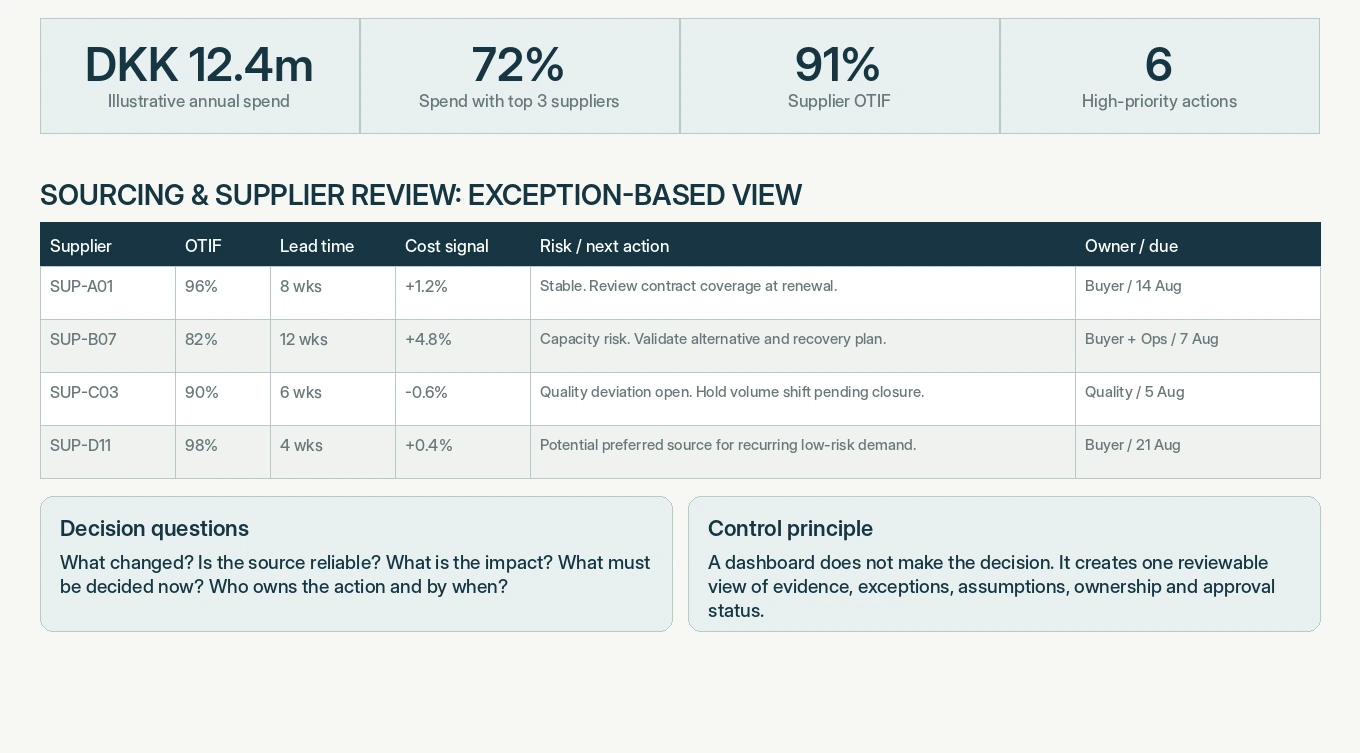
Reviewing supplier performance, risk and commercial terms together.
How supplier performance, commercial terms, capacity, lead time, inventory exposure and open actions were brought together for review and follow-up.
Supplier judgement: When higher volume put pressure on a supplier I had introduced, I worked with them to understand the bottleneck, redirected urgent work where needed and limited new commitments until capacity recovered.
Sourcing reviewSpend & performanceMHE + AssetIQ
02ERP, master data and production readiness
Documented experienceSanitised reconstruction
Keeping an approved change aligned before first production.
How an approved change moves through item data, BOMs, routings, materials, documentation and production readiness.
Operational proof: Before release, I checked the item, BOM, routing, material and documentation impact, then followed the changes through to first production.
AX & D365Prototype supportBOM and routing
06 · Problem solving and responsible use of technology
Understand the problem before choosing the tool.
When something keeps going wrong, I first work out whether we understand the real cause. I check the source information, what is affected and who needs to make the decision. Then I focus on a fix that people can actually use in day-to-day work.
TOOLS, WHEN THEY HELP
Tools such as root-cause analysis, impact mapping, structured checks, reporting, automation and AI are useful when they help that work. The tool itself is never the point.
Ishikawa root-cause review
Organise possible causes by evidence and test them before choosing a corrective action.
Source and impact map
Show which records are trusted, what changes downstream, who owns the decision and what remains open.
Routine and ownership check
Confirm that the new routine works in daily operations, has an owner and can be maintained.
TECHNOLOGY IN PRACTICE
Category procurement and AssetIQ in practice.
The work combines category procurement, MHE operations and AssetIQ. I would contribute from the category-user side: use trusted supplier, contract, spend and asset data, test whether workflows handle real sourcing scenarios, and challenge outputs that do not fit operational reality.
AssetIQ can bring asset, contract, supplier and operating data together to support comparison and category decisions. The workflow can support preparation and comparison; final commercial accountability remains with the responsible decision owner.
From ERP controls to AssetIQ workflow validation
Daily AX/D365 and MRP work taught me to question the information behind a decision: item and supplier data, planning parameters, dates, material availability and exceptions. I would bring the same business-side discipline to AssetIQ by validating approved inputs, testing normal and unusual sourcing scenarios, challenging outputs that do not fit operational reality, and confirming the decision owner before anything is scaled.
My rule for digital assistance
AI can help with research, data checks, scenario comparison and first drafts. Restricted data stays in approved systems. The relevant owner reviews the evidence and approves the final decision or output.
How I would pressure-test AssetIQ workflows
I would start with one real sourcing or supplier problem, validate the approved inputs, test normal and unusual cases, compare the output with what is happening in operations, and keep assumptions and decision ownership visible before action.
- RFQ, tender and negotiation preparation
- Spend, supplier, contract and asset-data checks
- Supplier performance, service and delivery exception monitoring
- Demand aggregation and standardisation opportunities
- Lifecycle, redeployment and sourcing scenarios with assumptions visible
- Pressure-testing workflows against normal and unusual category scenarios
AI use in this portfolio: I used AI for some drafting and code support while building this portfolio. I checked the career claims, rewrote the wording, tested the site and made the final decisions. Examples are sanitised. Confidential company records, identities and internal controls are not published.
07 · Relevant roles
Where my experience fits.
Technical Procurement & Sourcing
Technical purchasing, RFQs, supplier evaluation, negotiation, sourcing routes, alternative sources, sourcing decisions within delegated authority, purchase orders and supplier issue resolution.
Category Sourcing & Supplier Development
RFQs, tender inputs, supplier comparison, negotiation, supplier development and performance, demand aggregation and commercial follow-up. For MHE, lifecycle and operating requirements would be validated with the relevant stakeholders.
Procurement Operations & Supplier Performance
Open-order control, supplier data, delivery performance, shortages, exceptions, documentation and recurring follow-up.
ERP, Product Data & Technical Information
Items, suppliers, BOMs, routings, revisions, controlled documentation, planning parameters, approved changes, information quality and downstream business impact.
Supply Planning, Materials & Production Readiness
MRP, stock and incoming supply, shortages and backlogs, planning parameters, phase-in and phase-out, production priorities and production-order readiness.
Process Improvement & Quality Documentation
ISO 9001 routines, internal and process audits, 5 Why and Ishikawa root-cause analysis, scrap and rework improvement, standard work, FAI, NCR and SCAR, traceability and QMS support.
08 · How I start
How I would start in the role.
Learn the MHE category and operating reality
Learn demand, suppliers, contracts, fleet and asset data, regional stakeholders, operating requirements, current performance and AssetIQ workflow boundaries before changing the process.
Own one recurring MHE sourcing or supplier problem
Take one real issue from facts and assumptions through recommendation, supplier or stakeholder action and follow-up, while using it to test the relevant AssetIQ workflow.
Deliver one measurable category and workflow improvement
Baseline cost, service, risk or cycle time, implement the improvement, capture what worked in the workflow and agree the review rhythm, owner and next decision.

Category Sourcing · MHE · ERP & Data
Romaric Clementi09 · Contact
Procurement, supplier and data experience with an operational view.
I bring hands-on sourcing and supplier follow-up, warehouse and MHE experience and ERP and data work. I would apply that base to MHE lifecycle decisions, supplier performance and AssetIQ workflow improvement.